
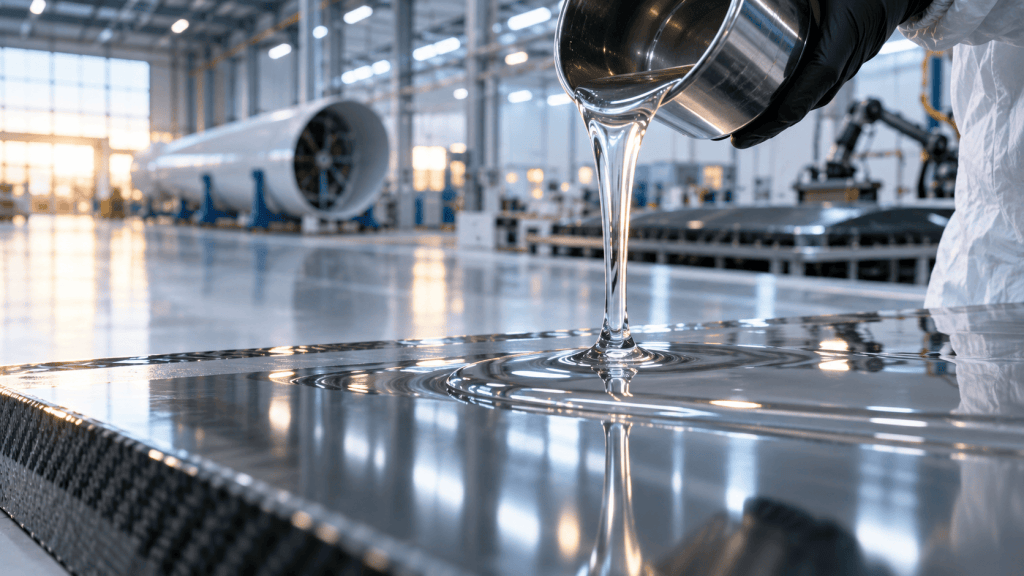
What Are Epoxy Resins, and Where Are They Used?
Epoxy is one of the most trusted materials in high performance manufacturing. Engineers reach for it when a bond has to survive vibration, thermal cycling, chemical exposure, or decades of service life and conditions where ordinary adhesives fall short. But what is epoxy resin, and why has it become the standard in industries like aerospace, automotive, electronics, and wind energy?
A Brief History of Epoxy Resin
Epoxy has been around longer than you’d think. Back in 1848, a French chemist named Marcellin Berthelot made a compound called epichlorohydrin. Epichlorohydrin us still used to make epoxy today. But epoxy itself wasn’t invented until almost 100 years later, and oddly enough, it was invented twice by two chemists who didn’t know about each other. In 1934, a German chemist named Paul Schlack found a way to link epoxide molecules together. A few years later, a Swiss chemist named Pierre Castan did something similar on his own and patented it in 1938. His version caught on: a company called Ciba bought his patent and started selling the first commercial epoxy glue, called Araldite, in 1946. Around the same time, an American chemist made something similar, which later became part of Shell Chemicals. Then in the early 1950s, the aerospace industry started using epoxy because it was light, strong, and could handle tough conditions. After that, it spread everywhere; coatings, electronics, construction, and more and it’s still valued for those same reasons today.
What Is Epoxy Resin?
Epoxy resins are an important class of polymeric materials, characterized by the presence of more than one three membered ring known as epoxy, epoxide or oxirane group. Once cured, it undergoes a permanent chemical reaction unlike a hot melt or solvent based adhesive that simply cools or dries, cured epoxy cannot be remelted or reshaped. That permanence is exactly what makes it so reliable in demanding structural and electronic applications. General representation of Epoxy Resin is as depicted in following picture.

Epoxy adhesives are generally formulated one of two ways:
- Two Part systems, where a resin and a hardener are combined in a specific ratio. Mixing triggers the curing reaction, and the system can be engineered for a wide range of working times, cure speeds, and final properties.
- One Part systems, where the resin and latent hardener are premixed and stable at room temperature. These systems cure on demand, typically with heat, offering a simpler, more consistent process on the production line; no mixing, no pot life to manage, no risk of an off ratio mix.
Many industrial formulations, including ours, are 100% solids meaning there are no solvents or volatile carriers that evaporate during cure. That translates to no shrinkage, no off gassing, and consistent, predictable bond lines every time.
How Epoxy Resin Is Made
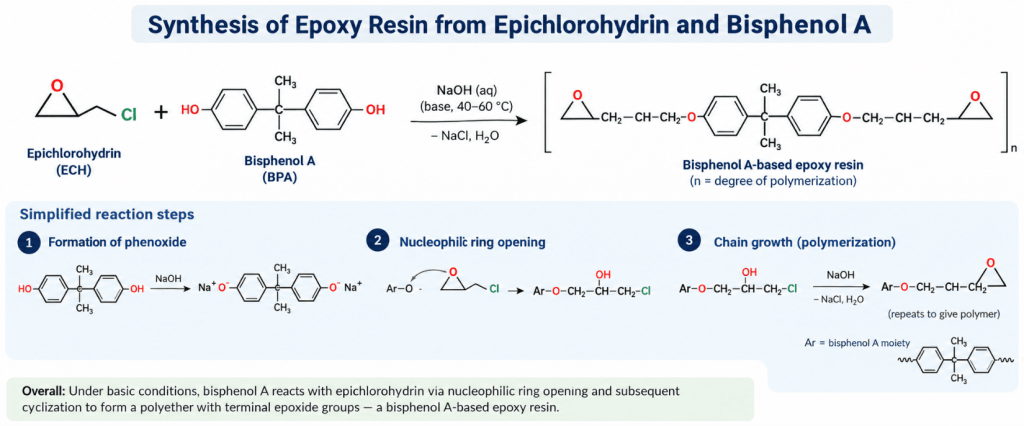
Most commercial epoxy resin is produced through a reaction between two petrochemical derived building blocks: Epichlorohydrin (ECH) and Bisphenol A
Are There Non-Petroleum Alternatives?
Yes and research in this area has picked up considerably in recent years, driven by sustainability goals, regulatory pressure around bisphenol A, and interest in reducing dependence on fossil feedstocks. None of these alternatives have displaced standard petroleum-based epoxy at industrial scale yet, but several are advancing from lab research toward real commercial use:
- Epoxidized vegetable oils: Oils such as soybean, castor, and linseed oil contain C=C double bonds that can be converted into epoxide groups through an oxidation reaction. Epoxidized soybean oil (ESO) in particular, has already reached some commercial use, most often as a plasticizer or as a modifier blended into conventional epoxy systems, though on its own it tends to have lower reactivity and heat resistance than petroleum based resin.
- Lignin based resins: Lignin is an abundant byproduct of the pulp and paper industry, and its naturally aromatic structure makes it chemically well suited to epoxy type networks. Researchers have used it both as a partial substitute in epoxy formulations and, more recently, blended with epoxidized soybean oil to create resins with a high percentage of biobased content.
- Other biomass derived feedstocks: Sugars, tannins, rosin, and cardanol (a byproduct of cashew nutshell processing) are also being investigated as renewable building blocks for epoxy type resins.
- Biobased epichlorohydrin: Rather than replacing the whole resin, this approach swaps one input: epichlorohydrin produced from plant-derived glycerol (often a biodiesel production byproduct) instead of petroleum derived propylene, while still using it in the same reaction with bisphenol A.
The general trade off across these biobased routes is performance versus sustainability: fully biobased resins have historically lagged conventional epoxy on properties like heat resistance, mechanical strength, and reactivity, which is why most commercial biobased content today shows up as a partial substitute or additive rather than a full replacement. That said, recent research has been closing the gap. Some recent lignin and plant oil based formulations are being engineered to approach or match the thermal and mechanical benchmarks of conventional resin. For our own product lines, this is a space we continue to watch closely as the performance case matures.
Why Are Epoxy Adhesives Widely Used?
One of the biggest advantages of epoxy adhesives is their ability to bond to many different materials such as metals, aluminum, concrete, wood, composites, fiberglass, plastics, etc. This makes epoxy useful when mechanical fasteners such as screws, bolts, or rivets are not practical or when manufacturers want to reduce the number of mechanical components in a product. Epoxy adhesives can also spread loads over a larger surface area. Instead of concentrating force around a bolt or screw, the adhesive can distribute stress across the bonded area. This can help improve product performance.
Why Manufacturers Choose Epoxy Adhesives
- Structural strength: cured bonds can meet or exceed the strength of mechanical fasteners or welds, often while distributing stress more evenly across a joint.
- Chemical and environmental resistance: resists fuels, solvents, moisture, and temperature extremes over long service life
- Electrical insulation: critical for potting and encapsulating sensitive electronics.
- Design flexibility: bonds dissimilar substrates (metal to composite, glass to plastic) without the added weight or stress concentration of mechanical fasteners.
- Process efficiency: one part systems simplify automated dispensing and reduce line variability.
Where Epoxy Adhesives Are Used
Aerospace
Epoxy structural adhesives bond composite panels, honeycomb structures, and metal components where weight savings and fatigue resistance are critical. Aerospace grade formulations are engineered to perform reliably across extreme temperature swings and long service intervals.
Automotive
From structural body bonding to panel lamination, epoxy adhesives help manufacturers reduce vehicle weight, improve crash performance, and bond mixed materials (steel, aluminum, composites) that welding can’t easily join.
Electronic Potting and Encapsulation
Epoxy potting compounds protect sensitive electronic assemblies such as sensors, connectors, control units from moisture, vibration, dust, and thermal stress. Because epoxy is an excellent electrical insulator, it protects circuitry without interfering with performance.
Structural Adhesives
Across general industrial manufacturing, structural epoxies replace or supplement rivets, bolts, and welds distributing load more evenly, sealing joints against moisture and corrosion, and enabling lighter-weight assembly designs.
Wind Energy
Wind turbine blades rely heavily on structural adhesives to bond composite components together. These bonds must withstand decades of cyclic loading, weather exposure, and vibration making toughness and long term durability essential.
Electrical
Epoxy systems are widely used for insulating, sealing, and protecting electrical components and assemblies, offering dielectric strength alongside resistance to moisture and environmental stress.
Construction
Epoxy systems are used in construction for Concrete repair, Anchoring, Crack repair, Structural bonding, and Stone bonding offering high strength and durability in demanding environments.
The Bottom Line
Epoxy adhesives have become a foundational material in industries where performance, weight, and reliability can’t be compromised. Whether you’re bonding composite structures in a wind blade, potting sensitive electronics, or replacing mechanical fasteners in a structural assembly, choosing the right one part or two part, 100% solids epoxy system is key to long term performance.