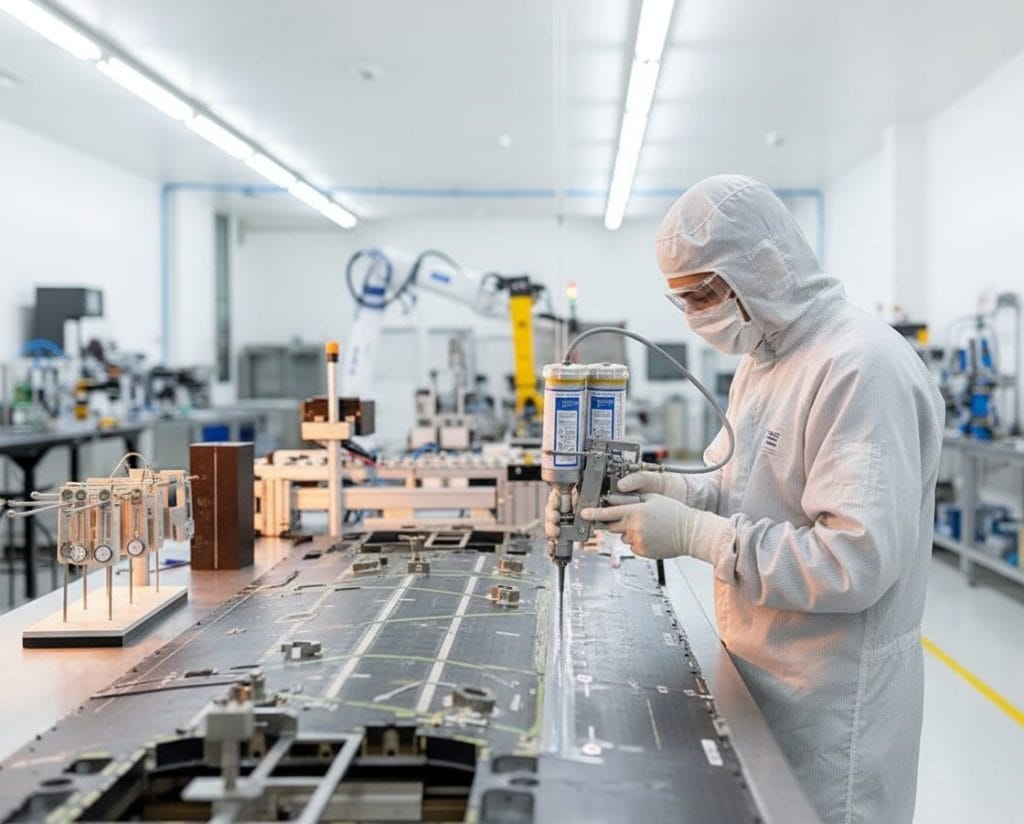
Worker applying sealant to a vehicle body component
PRODUCT DESCRIPTION

A Custom Automotive Sealant Built Around Your Requirements

Your substrates, operating environment, service temperature, and mechanical loads all shape the formulation. We formulate your automotive sealant to perform reliably under those combined demands.
  • AS9100D and ISO 9001:2015 quality management behind every batch
  • UL-recognized materials for demanding electrical and thermal environments
  • One- and two-component heat-cure epoxy/anhydride systems
  • Direct chemist access from first brief through final qualification
Technician working in a cleanroom production area
Applications

Where Our Industrial Sealants Perform

From aerospace and automotive to electronics and renewable energy, manufacturers come to us for industrial and automotive sealant chemistry built to spec.
Robotic sealant application on an electronics housing

Electronics and Electrical

potting, bonding, and sealing that shield sensitive assemblies from moisture and heat.

Automated dispensing of sealant onto an electronic assembly

Aerospace

certified chemistry for structural components where traceability and documentation are mandatory.
Automotive body panel on an assembly line

Automotive and Transportation

an automotive adhesive sealant that withstands road vibration, temperature extremes, and fluid exposure.
Sealant being applied to a building window frame

Construction and Infrastructure

durable seals for joints subject to weather, movement, and long service demands.
Adhesive being applied to an aluminium honeycomb aircraft panel

Maintenance and Repair

fast-curing compounds that restore bonds on site without lengthy downtime.
Sealed metal joint on a driveshaft assembly

Filtration, Wind, and Renewable Energy

systems that resist fatigue and humidity across decades of operation.
  • AS9100D
    Certified Manufacturer
  • ISO 9001
    Quality Management
  • 50+
    Years Structural Bonding
  • Fast
    Qualification Cycles

Frequently Asked Questions

Here are the questions engineers ask us most often, answered before you submit your project brief.
What makes your automotive sealant different from an off-the-shelf product?

Standard suppliers sell the nearest stock item and expect you to work around it. We do the reverse, developing the exact chemistry your joint requires based on its substrates, service conditions, and load profile. That starting point is what separates a formulator from a distributor. The payoff is a seal that behaves the same in production as it did in the lab.

How do you determine the right sealant chemistry for my application?

We start by looking at the whole picture: your substrate, service conditions, performance targets, manufacturing method, and any OEM or regulatory specs. Only then do we point you toward the right chemistry. Whether it’s epoxy, polyurethane, acrylic, UV/EB cure, or a hybrid, the platform follows the problem.

Which chemistries do you formulate?

The range covers one- and two-component epoxy, two-component polyurethane, and two-component acrylic systems, alongside an industrial-grade silicone sealant when a use case demands it. Each family is chosen for the mechanical, thermal, and chemical requirements in front of it.

How fast can you deliver a qualified automotive sealant?

A compact team of chemists means shorter approval chains and quicker iteration than a large enterprise supplier can manage. Timelines vary with the complexity of the bond, but a focused group consistently moves from brief to approved compound faster than a catalog-driven vendor. We share candidate results early and refine in tight loops, so qualification does not stall behind a long corporate queue.

Will my proprietary formulation stay confidential?

Yes. Protecting a client’s intellectual property is fundamental to how a trusted industrial sealant partner works. Confidentiality is written into how we handle every engagement.

OUR JOURNEY

Three Decades of Formulation Excellence

Built on Experience. Driven by Innovation. Defined by Quality.
1

Submit Engineering Brief

2

Chemistry
Review Call

3

Lab
Formulation

4

Application
Testing

5

Qualification
Data Package

6

Production
Approval

Innovative Resin Systems laboratory workspace